Mental health at work
Most people who are struggling still turn up to work. That makes managers and colleagues some of the best-placed people to notice, and to ask.
This page is for anyone worried about someone at work, and for anyone whose work is grinding them down.
If you're worried about a colleague
You don't need a qualification. You need to notice, and ask.
Notice the change, not the diagnosis
You're not there to work out what's wrong. Just notice they seem different, and say so.
Ask somewhere private
A quiet "how are you, really?" away from the desk does more than any wellbeing poster.
Know your EAP
Many UK employers have an Employee Assistance Programme with free, confidential counselling. Find the number before you need it.
Don't try to fix it
You're not their therapist. Listening, and pointing them to the right support, is the job.
Follow up
One conversation rarely fixes anything. A second check-in a week later is often the one that lands.
What to say, and what to avoid
There's no perfect script. Being kind and direct beats getting the words exactly right.
Things that help
- "I've noticed you've seemed a bit quiet lately. How are you doing, really?"
- "You don't have to tell me anything. I just wanted you to know I've noticed, and I'm here."
- "Is there anything that would make work easier right now?"
- "Are you thinking about suicide?" If you're worried they might be, ask them straight. It doesn't put the idea in their head.
Things to avoid
- "Cheer up" or "others have it worse". It tells them to stop talking.
- Guessing a diagnosis. Leave that to their GP.
- Turning it into a performance conversation. Keep the two separate.
- Promising to keep it secret if they tell you they're not safe. Their safety comes first.
- Raising it in front of other people.
A five-minute toolbox talk
Read this out at a team briefing, a shift handover or a site meeting. It works best said in your own words.
Start
Today's talk isn't about deadlines or kit. It's about each other, and it'll take five minutes.
Why it matters
Most of us know someone who's struggled with their mental health. A lot of people who are struggling still come to work every day, and nobody notices. We can change that.
What to look out for
Someone going quiet, snapping more than usual, turning up late, drinking more, or saying things like "what's the point". You don't need to know what's wrong. Just notice they're different.
What to do
Ask them, somewhere private: "How are you doing, really?" Then listen. You don't have to fix it. If you're worried they might be thinking about suicide, ask them straight. It won't put the idea in their head.
Where to get help
If it's an emergency, call 999. Samaritans are there 24/7 on 116 123, free. You can text SHOUT to 85258. Our Employee Assistance Programme number, if we have one, is: ____________________. Everything else is on notokay.co.uk.
Finish
It's ok to be not okay. If that's you today, come and talk to me, or anyone here, after this. If it's someone you know, send them a text tonight.
Put up a poster
For a staff room, canteen, site cabin or toilet door. Free to print and copy. "Print-friendly" versions use far less ink.
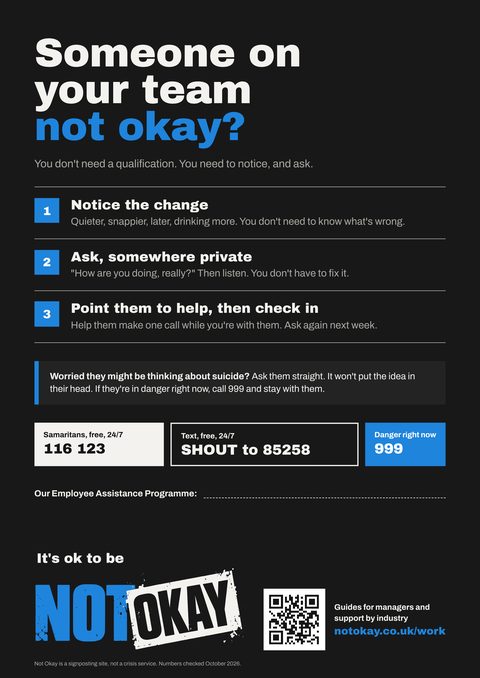
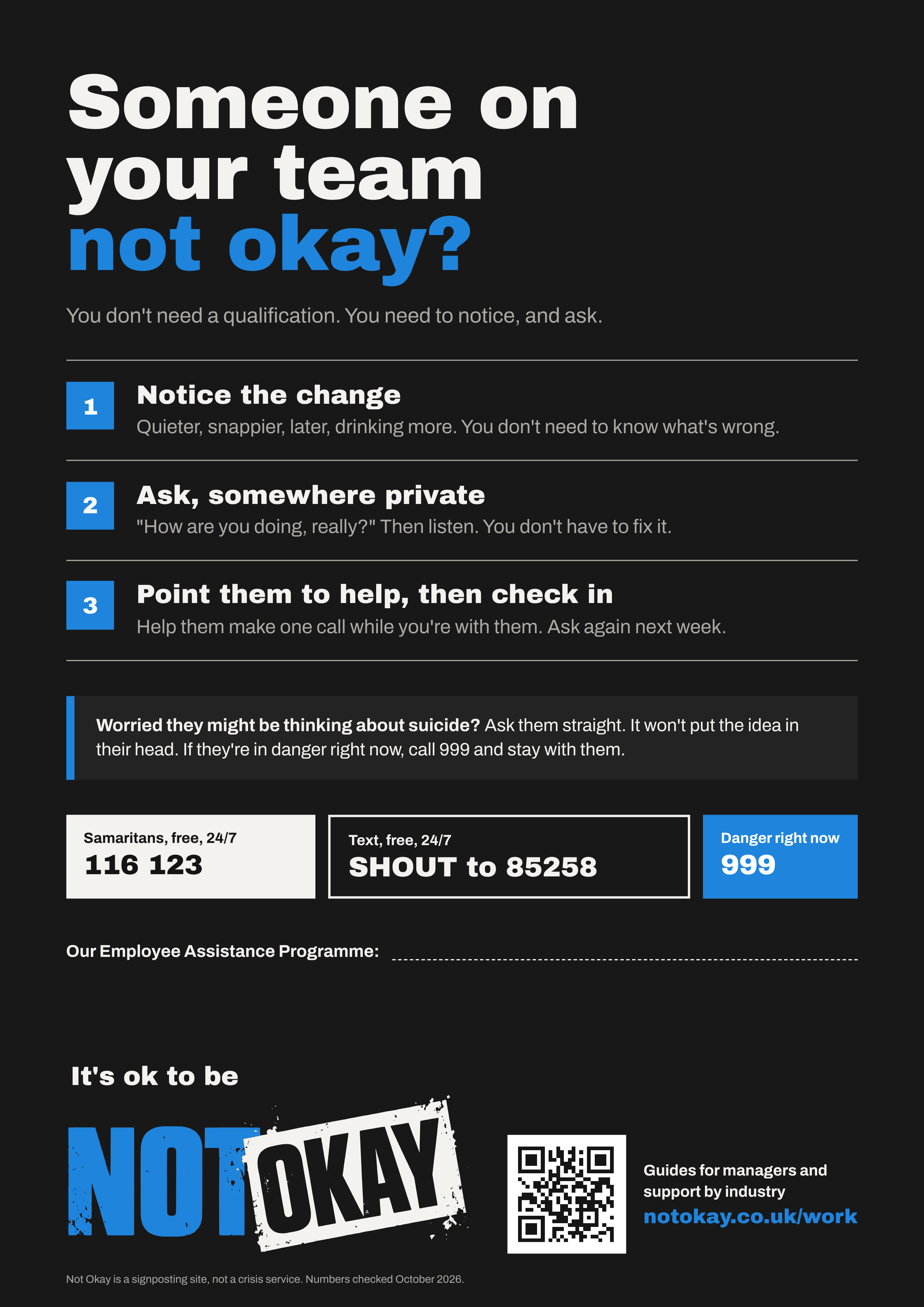
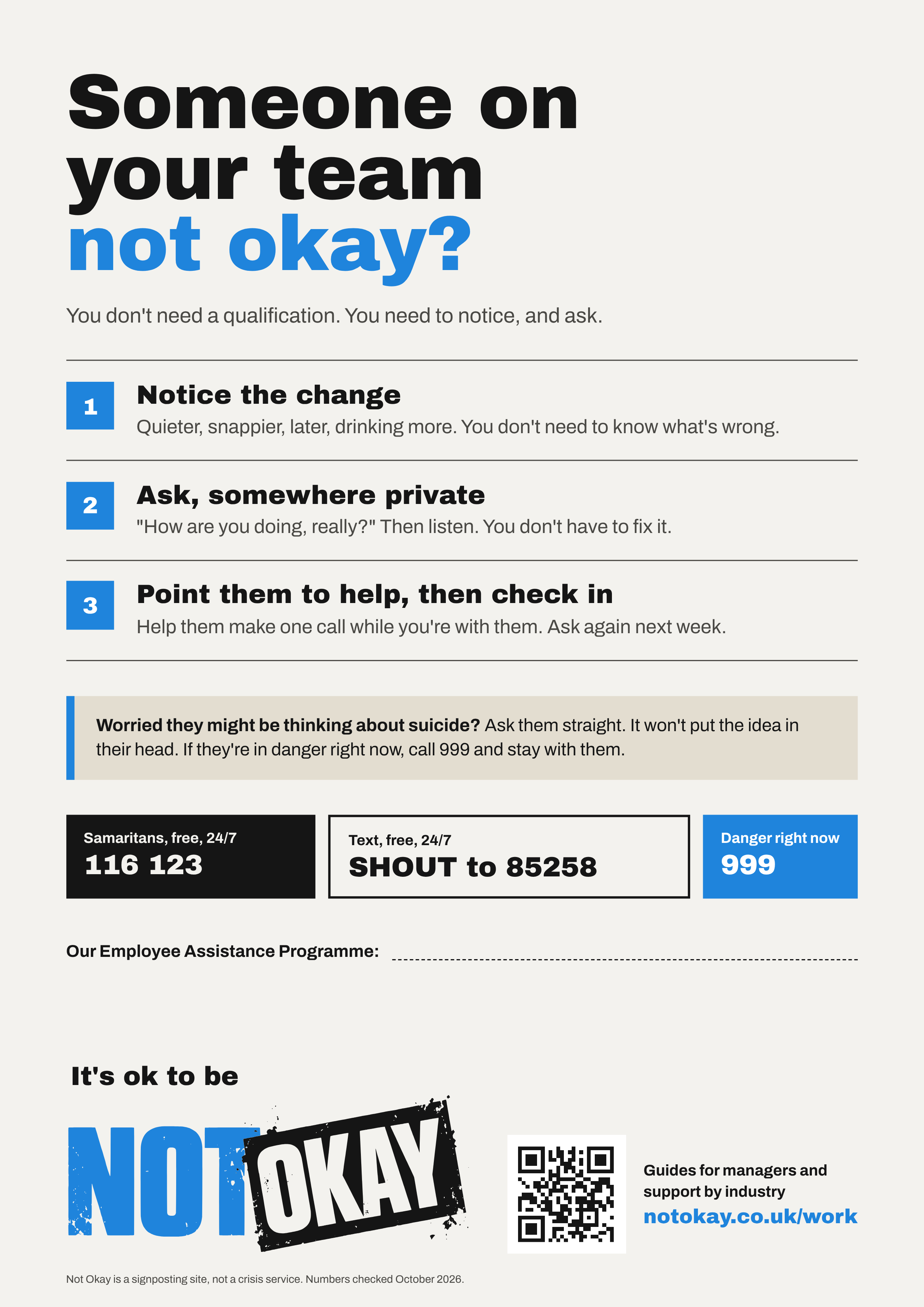
Someone on your team not okay?
Three steps for colleagues, the key numbers, and a space to write in your Employee Assistance Programme.
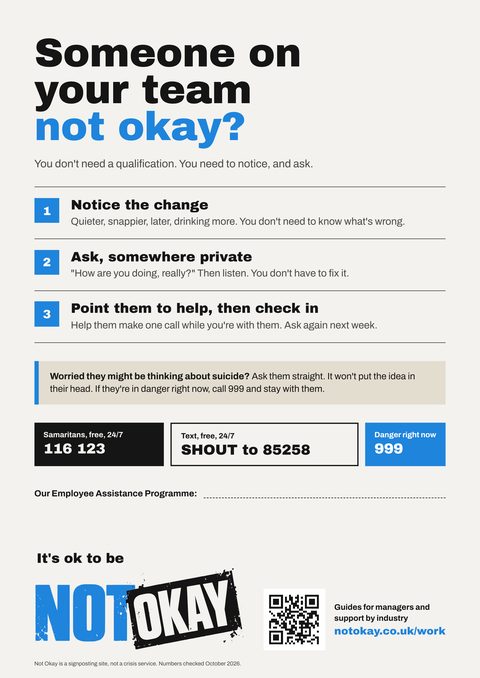
Someone on your team not okay? (print-friendly)
The same workplace poster on a light background, for office printers.
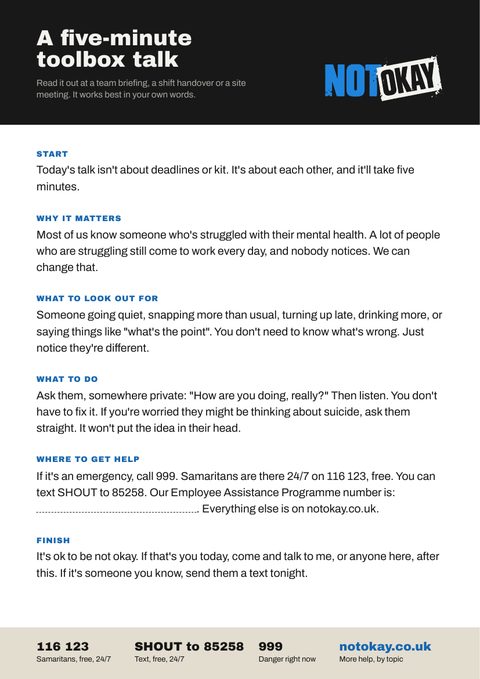
A five-minute toolbox talk
A script for a team briefing, shift handover or site meeting, with a space for your Employee Assistance Programme number.
If work is grinding you down
Start with your employer's Employee Assistance Programme if there is one. It's confidential and separate from HR. Otherwise the Mind Infoline can point you to support, and your GP can refer you for talking therapy if it's tipping into something bigger.
Support by industry
Some industries have their own support. These are free and confidential.
Lighthouse Construction Industry Charity
lighthouseclub.orgEmotional, physical and financial wellbeing support for the construction community. Numbers on their website.
Farming Community Network
03000 111 999Confidential support from volunteers who understand farming, for personal or business worries. Email help@fcn.org.uk.
Mates in Mind
matesinmind.orgGuidance and training to help employers improve mental health at work.
Mind: emergency responders
mind.org.uk/ourbluelightMind's information and links for people working or volunteering in the emergency services.
Mind Infoline
0300 123 3393Not a crisis line. Helps you find local services, treatment options and advocacy.
Samaritans
116 123For anyone struggling to cope. You don't need to be suicidal to call.
Nothing matches that filter.
Did you find what you needed?
One tap, counted anonymously. We can't see who you are.